Showing posts with label hiking. Show all posts

Wednesday, March 30

Banana Nut Energy Bars


Spring brings an increase in outdoor activity for all kinds of animals—even the two-legged variety. Of course, a lot of us love getting outside all winter long for snowshoeing and skiing, but the clear roads, warmer temperatures and longer days of the new season make it even easier to get outside and to stay out for longer stretches.

For many sports enthusiasts, it also marks the start of the training season to get ready for early-summer races and events. Road running, trail running, cycling, swimming and paddling are all popular around here in terms of both casual sports and competitive sporting events. Band on the Run, Spin the Lakes, the Limberlost Challenge, Muskoka River X, and Muskoka Ironman 70.3 are just some of the organized sports events in the area. Between races, the region has become a training destination thanks to our fresh air, challenging hills and variety of terrain.

Since the snow has started to clear out, Jim and I have swopped our snowshoes for running shoes and have been hitting the roads and parks in preparation for some running races (and in Jim's case a triathlon) in the coming months.

A big part of training includes fuelling for the increased activity level. There are all sorts of commercial energy bars out there for portable, accessible fuel but one look at the ingredient list can make them lose some appeal. If you'd rather know what you're putting in your body, it's easy to make your own energy bars at home. We like these Banana Nut Energy Bars for a quick boost before a run or to replenish our reserves afterwards.


Banana Nut Energy Bars


These bars are moist, dense and hold together well. Feel free to replace the almonds and walnuts with other nuts or seeds, or to swop out the dried cherries for dried cranberries, raisins or other dried fruit.
  • 1 1/2 cups rolled oats, divided
  • 1/2 cup unsalted sunflower seeds
  • 1/4 cup ground flax seed
  • 1/2 cup dried apricots
  • 1/2 cup pitted dried dates
  • 1/2 cup sliced almonds
  • 1/2 cup walnut pieces
  • 1/2 cup dried cherries
  • 3/4 teaspoon salt
  • 1/2 teaspoon cinnamon
  • 1 medium-size very ripe banana
  • 1/3 cup pure maple syrup
  • 2 large eggs
  • 1 teaspoon pure vanilla extract

Preheat oven to 350°F. Line a 9” square pan with parchment paper, leaving overhang.

In a food processor, whirl 1/2 cup oats until fine. Add remaining oats, sunflower seeds, flax seeds, apricots and dates. Pulse until apricots and dates are diced into pieces no larger than a chickpea.

Transfer mixture from food processor into a large mixing bowl. To mixture, add almonds, walnuts, dried cherries, salt and cinnamon. Stir to combine.

In the same food processor, whirl banana, maple syrup, eggs and vanilla until smooth. Pour over mixture in bowl and stir to combine thoroughly.

Press into prepared pan. Bake until firm and lightly golden, about 20-25 minutes. Cool in pan then slice into bars or squares. Makes 18 bars, more or less, depending on how you slice it.

Fuel up and get active!

Monday, September 30

September at the Little Lake


Many of our guests enjoy a morning walk up the Seguin Trail to a little lake which we simply call "the little lake". It's about 25 minutes each way depending on your pace and how often you stop for photos, and you could certainly go farther if you wish. As a former railway bed, the trail goes all the way to Parry Sound!

Recently, one of our repeat guests, Brenda, rose early on a misty morning while her travel mate slept and was rewarded with some beautiful images of the lake and trail. She was kind enough to share them with all of us...


.: Thank you, Brenda!  :.

A week later, I followed suit and set out to capture the play of morning mist and light over the water and trees. I didn't have as much mist, but that's okay because the fall colours by then had started to really pop. This is what made it worth the early morning for me...


Do you have photos from your visit with us that you'd like to share? Post them to our facebook page of send us a link to your gallery. We'd love to see them!

Monday, September 9

Discovery Routes Sprucedale Trail

View from the boardwalk.

It was a sunny September afternoon so we decided to finally check out the Sprucedale Trail. We've been meaning to for over a year now but, perhaps because it's so close to home, it just hasn't been a high priority for us. Well, I'm glad we finally did!

Jim, Saba and I took a short drive up over to the town of Sprucedale, just 14 km north-west of the inn, to the trailhead located just behind the skating rink and soccer field by the township office.

The trailhead is well-marked and most of the trail is as well, though we did get a bit off-track at one point. It's not a single loop, so I recommend taking a photo of the trail map before you start and have it with you for reference along the way. That said, it's only a 2km trail so getting a bit lost is not a big deal knowing you can always turn around and follow your path back out the way you came.

The trail starts off with a floating boardwalk across a beaver pond. Photography enthusiasts will find it worth their time just to go for this leg alone, even if they don't bother to hike the rest of the trail.

The trail starts with a scenic boardwalk over a beaver meadow.
While most of the trail is dry, climbing through hardwoods and rocky outcrops, be prepared to get your feet wet or muddy. There was a stretch of trail that was like a wet sponge. It was springy and watery, with the occasional patch of deep black mud. This was not a big problem for Jim and I. We humans could walk around the mud for the most part or stay above it by stepping on fallen branches and stumps.

The dog, however, delighted in barreling right through it, sometimes sinking knee-deep in it. The odour of bog-dog was... have you seen the movie Labyrinth? Remember the Bog of Eternal Stench? Yes, like that. Thankfully, this section was near the beginning of the trail and by the end, Saba's legs were dry and brushed clean by the grasses and scrub along the way.

From low wetlands to high-and-dry scrub.

The trail description on the Discovery Routes website mentions "the talking rock". We saw plenty of big errant boulders and rock ridges, but we weren't sure if any of them spoke. If you know what the talking rock is, please let us know or send a picture!

What was that? Did this rock just say something?

All in all, a nice trail for an afternoon hike. We followed it up with a scenic back-road drive up to Katrine for some fish and chips (best chip truck ever!) which we enjoyed back here on the "upper deck" by the Coop.

Don't forget to look up.

The Sprucedale Recreational Trail is part of the Discovery Routes network of trails. Discovery Routes is a volunteer-run not-for-profit organization dedicated to maintaining and promoting trails in the Almaguin Highlands, North Bay and Mattawa area.

Beaver route.

Dry, open clearing.

Close up.

Hardwood hills.

Nothing like a good hike to put things in perspective.

Tuesday, March 5

Winter Beaver Field


One of the many things I love about snowshoeing is its ability to take me places in winter I can't get to at any other time of year.

There are swaths in the forest littered with fallen tree trunks, up-ended root plates and dense new growth. Picture a giant's game of 'pick up sticks'. In the summer, it's impossible to traverse over or through these tangled woods. In the winter, though, it's a different story. Snow levels it all out. It fills in the deep spaces, drifts around and over obstacles, smoothes the ragged jangle into graceful rolls and mounds. With snowshoes on to disperse your weight, you can walk right over top of fallen timber and small trees.

The other benefit of winter has to do with water obstacles, not wood ones. When lakes, ponds and marshes freeze over, we can, in a sense, walk on water and explore areas otherwise inaccessible. And that's exactly what we did this week.

If you've read my post about the beaver activity in our forest, you know those hard-working rodents have created exactly the kind of environment I've just described: layers of debris from felled trees plus a murky pond of unknown depth. Impassable -- but only until the snow accumulates. That's when we strap on the snowshoes, grab the camera, and head out to explore. This week we tromped over to the beaver pond and discovered it was now a beaver field.

As we were snowshoeing along a slight ridge in a fairly open area, we realized we were actually walking on a beaver damn. Our suspicions were confirmed when we came across an air or access hole in the damn. As we wound our way over the field/pond, we also found the beaver lodge, a mound the size of a pup tent, and again with an air or access hole in the top.

We saw other signs of beaver activity in the area, including a small felled tree with some of the bark chewed off and a number of other recently-gnawed trees.

The ridge is a beaver dam.
Air or access hole on the beaver dam.
A peek down the hole.
Beaver lodge.
Gnawed tree.
Lunch time!


Thursday, November 15

Track and Tower Trail


It was a beautiful November day -- mild temperature, sunny breaks, and my birthday to boot! -- so we headed over to Algonquin Park for an afternoon hike. I got to choose the trail and since I've never done the Track and Tower Trail, and because I wanted to make good use of a particularly fine day, that was the one I chose.

It's a 7.5 km trail including the side loop over to the lookout point. It's definitely worth the extra couple of clicks to get that view! We did it in just under 3 hours with brief stops for snacks and photos. The Algonquin Park trail guide recommends allowing 4 hours for the hike and that's about right for a leisurely pace. It's also wise to err on the side of caution when planning a hike at this time of year. The days are short and there are fewer people on the trails so it's important to start a trail only if you know you can finish well before the sun goes down.


The trail followed Cache Lake to start.
Rivers, rapids, and bridges make for interesting sights and sounds along the way.
A few sections of the trail use boardwalks to protect the land and/or our feet.
A lovely little waterfall cascade. We could hear this one well before we could see it.
Over 130 steps up to the lookout and back down again.
The view from the top! Totally worth the stairs!
Part of the trail follows an old train track. It ends rather abruptly where a bridge used to span a river.
And it picks up on the other side where it left off.
The old track sections make for some easy, level walking.
Even though the ambient temp was 15°C, these frozen little waterfalls stayed cold against the rock face. 
Cool curtain of ice!
Old footings, remnants of a train trestle.
A river runs through it.
Hike complete! Either I'm doing a happy dance or I'm trying to get untangled from the leash. Either way, what a great day!

Saturday, April 21

Reading the Forest - Peek into the Past

In my last post, we read the signs of animal activity in the forest. It amazes me every time to see how much is going on every day in our own patch of woods. But there's more than just current animal tales to see. If we know what to look for, we can peek into the past and see how the land was shaped by settlers over a hundred years ago and by the forces of nature over millennia.

Ancient bedrock. Somewhat-less-ancient Jim and Saba.
If we start at the beginning of the narrative, we'll have to go back a few billion years to the Precambrian era which is when the Canadian Shield formed. The exposed bedrock you see as you travel through the region is some of the oldest in the world. Though the elevation is quite low now, these rocks are the roots of ancient mountains, eroded over time and rising up (like an iceberg) above the mantle below.

If this wall could talk...
Glaciers advancing and receding over Canada over twelve thousand years ago also left marks we can still see during a walk in the woods today. The ice sheets of the glacial period picked up and transported rocks and debris as they moved, scraping away soil and scouring lake basins. Every time I see a lonely bolder sitting amid a stand of trees I wonder if it was dropped there by a glacier "back in the day".

Was this boulder left behind by a glacier?
It can be easy to assume, when I'm surrounded by tall, strong trees, that the soil here is rich and deep. But then, after a windstorm perhaps, I'll see a healthy tree has come down with it's root system still attached. And I'll see the roots have only been growing in a mere foot and a half of soil which was lifted--intact--off solid rock as the tree fell.

You can see solid, bare rock on the other side of those roots.
You can see the sparseness of the soil over bedrock (and the stubborn determination of these trees to grow in it anyway) when you see a tree with it's roots spread out over the ground instead of reaching deep down into it.

Big, beautiful tree is holding on to a thin layer of soil over rock.

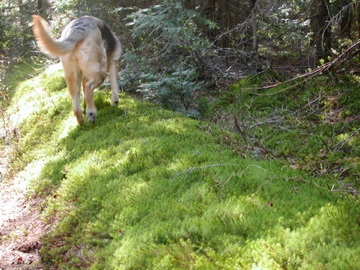
Saba walking on a furrow.
Turning the pages of the history book forward, the signs of recent history are easier to see and decipher. This land was settled as part of the Land Grants program in the 1880's. One of the conditions of the deal was that settlers had to clear 40 acres for farming (which would not have been an easy task). We can still see the furrows, now covered in moss, very clearly on our Mossy Trail.

You can still see the furrow (now covered in moss) from the farm days.
Throughout the property are piles of fieldstones. Every stone in every pile would have been lifted by hand and piled up out of the way of the field work. Very likely it was a job for the children to do.

One of many piles of fieldstone throughout the property.

Nicely intact section of fence, perhaps 100 years old.
In one spot just off the Mossy Trail, you can see the remains of a split rail fence covered in a lovely, vibrant moss. Was this to keep cows in? To mark a border? How long was it and who built it? We don't know and probably will never find out.

There are many narratives only hinted at throughout the forest--of current activity as well as the recent and distant past. Take a walk, keep your eyes open, and enjoy the mystery as much as the answers.


You can glimpse the split rail fence from the Mossy Trail.
: :   : :   : :

Discover the stories of the wildlife in our woods in Reading the Forest - Animal Tales.