Monday, June 11

Band on the Run 2012

The racers starting the half marathon. The sky was overcast but the air was muggy and heavy.
Runners, supporters, volunteers and sponsors filled River Mill Park in downtown Huntsville for the first Huntsville Half Marathon - Band on the Run. The event offered three race distances--5k, 10k, and half-marathon (21.0957km in case you're wondering)--and with over 300 racers total, it was a huge success for the first year.

Next, the 10k runners start out. That's Jim wearing #142.
A few canoe-heads and a troop of firefighters begin the 5k run.
Some of the highlights of the 5k run were the "canoe-heads", including our friend Randy Mitson and two of his colleagues from Algonquin Outfitters, portaging (yes, carrying a canoe!) the entire distance and a group of Huntsville firefighters running in their heavy bunker gear.

The 5k finish line. Cheers to the Huntsville Fire Department!
Now that's determination. The firefighters ran the full 5k together in their heavy gear under a blazing sun. It was 32°C by the afternoon and it was hard enough to stay cool in shorts and tees!


Our very own Jim ran the 10k and came in 9th overall out of 108 runners and 2nd for his age group. I'm so proud of him! Next up for Jim: his first try-a-tri and eventually a triathlon.

Overall, the event was a great day filled with music, food and community spirit. The organizers have said they'll do it again next year so we hope to see you here!

Back at home, Jim with his medal and prize. The next day he was walking a little slowly...

Thursday, May 31

Moose Sightings


Spring is a great time to see moose as you're driving the roads and highways of the region. In early spring, the animals are drawn to the tasty road salt that has washed into the ditches.

Later, in May and June, when the bugs are thick in the deep of the woods, moose come out to the road sides where the open air and breezes give them a break from the black flies and mosquitos.

We've seen a lot of moose this year and our guests have reported seeing them, too -- sometimes multiple sightings in one visit! The big beasts have been spotted on Fern Glen Road, Hwy 11, and (of course) Hwy 60 in Algonquin Park.


We always tell our guests: If you're driving along Hwy 60 in Algonquin Park and you see cars pulled over on the shoulder, stop (carefully) and pull off road. Chances are someone has spotted a moose! It's generally safe to get out of the car and take pictures as long as you keep your distance from the moose. While they are typically not aggressive, they are still wild animals -- make that BIG wild animals -- and must be respected.


On busier, faster highways such as Hwy 11, it's best to just drive on by and not create a road hazard by stopping. I've been lucky in that I saw two moose beside Hwy 11 just as I was getting to my exit. Since there were no cars behind me, the off-ramp was a safe place to slow down and pull over for a better view.


I can't talk about seeing moose from the road without a warning about moose on the road. If you see a moose on the road ahead, put your four-way blinkers on and slow down. Stop if necessary. Give the animal space and time to get safely off the road. Drive slowly on winding country roads and use your high beams (don't forget to switch back to low beams when approaching on-coming traffic or coming up behind another vehicle). 


Wednesday, May 23

June Events in Muskoka & Almaguin

There's lots happening in and around Muskoka, Algonquin Park and the Almaguin Highlands in June and beyond. You can also like us on facebook to keep up to date with news and events.

: :   : :   : :   : :

Huntsville Home Show
Canada Summit Centre, Huntsville
Home and lifestyle show, including health & wellness, decor, leisure, sports & recreation, and more. Seminars, demos, entertainment, food, vendors and giveaways. Visit the Hunstville Home Show for details.
May 26 & 27

Spin the Lakes Cycle Tour
Huntsville
Great day to cycle the scenic roads of Muskoka. Four distances to choose, from 20km to 170km. Visit Muskoka Cycling Club Spin the Lakes for details.
May 27

The Huntsville Half - Band on the Run
Huntsville
Lace up your running shoes for a 5km, 10km or Half Marathon run. The day includes great music, food and fun while raising money for Habitat for Humanity. Jim is running the 10km and hopes to see you there! Visit The Huntsville Half - Band on the Run for details and to register.
June 10

The New Moon in June Star Party
Mew Lake Campground, Algonquin Park
Join volunteers from the Toronto Centre of the Royal Astronomical Society of Canada as they view the Algonquin night sky. Telescopes are set up on the beach for a first-hand look. At Mew Lake Campground beach (at km 30.6 along Highway 60). Visit Ontario Parks Events for details.
June 14

The Cottage Dog Show
Canada Summit Centre, Huntsville
A weekend expo all about pooches in Cottage Country. Demos, performances, contests, vendors and more. Visit Cottage Dog for details.
June 15 - 17

Aboriginal Day Celebration at Muskoka Heritage Place
Huntsville
Tour a First Nations museum display and encampment. Learn traditional teachings that resonate with today's environment. Visit Muskoka Heritage Place for details.
June 21

Burk's Falls Rodeo
Fair grounds, Burk's Falls
The Ontario Rodeo Association comes to the Almaguin Highlands for the Canada Day weekend. Featuring bareback bronc riding, saddle bronc riding, steer wrestling, team roping, barrel racing, bull riding and more. Visit the Ontario Rodeo Association for details.
June 30 - July 1

Friday, May 11

Butternut Cranberry Waffles with Cranberry Maple Syrup


Last fall, I was asked by Savour Muskoka (an organization promoting food producers and artisans in the area) to contribute a recipe to be included in a calendar. The recipe was to highlight locally-grown products and ideally it would be suitable for making throughout the year and not just during the short growing season.

Butternut squash, cranberries and maple syrup are all produced in Muskoka and they all have longevity beyond their harvest time. And they all taste absolutely delicious when combined in these hearty waffles!

Savour Muskoka hit some snags and never did print those calendars, but this is a recipe worth sharing at any time of year.

Butternut Cranberry Waffles

We love butternut squash for the sweet, mild, nutty taste but any winter squash (or canned pumpkin) can be substituted.

Winter squash—such as butternut, hubbard, and kabocha—are harvested in the fall before the first hard frost. They can be stored in a cold cellar or other cool, dry place for many months and the prepared puree can be frozen in pre-measured portions for easy convenience. Fresh cranberries freeze beautifully (do nothing to them but toss them in a ziptop freezer bag). This allows us to enjoy our local produce long after the growing season has ended.

Makes 4 servings
  • 1 cup unbleached all purpose flour 
  • 3/4 cup whole wheat flour
  • 1 teaspoon baking powder 
  • 1/2 teaspoon baking soda 
  • 1/4 teaspoon salt 
  • 1/4 teaspoon ground cinnamon 
  • 1/4 teaspoon ground ginger 
  • 14 teaspoon ground nutmeg 
  • 1 cup butternut squash puree* 
  • 2 eggs 
  • 1 tablespoon sunflower or vegetable oil 
  • 1/3 cup pure maple syrup 
  • 1 cup buttermilk (or plain milk soured with a splash of lemon juice) 
  • 1 teaspoon vanilla extract 
  • 1/2 cup dried sweetened cranberries 
In a large mixing bowl, whisk together flours, baking powder, baking soda, salt, and spices.

In a medium bowl, whisk together the butternut squash puree, eggs, oil, maple syrup, buttermilk and vanilla.

Add the wet ingredients to the dry and stir until just combined. Don't over mix (a few lumps are okay). Let the batter rest for 20 minutes.

While the batter is resting, soak the dried cranberries in hot water for 10 minutes to plump up. Drain in a mesh sieve. Stir the drained cranberries into the batter.

Cook the waffles in a preheated, greased waffled iron according to manufacturer's instructions.

Serve waffles hot, topped with Cranberry Maple Syrup, toasted pecans and a dusting of icing sugar. Enjoy!

* To make butternut squash puree: Carefully cut squash in half lengthwise. Scrape out and discard seeds and strings (or bake seeds until toasted and eat as a snack!). Place squash halves cut side down in a baking dish. Add 1/2" water to the dish. Bake in a hot oven until tender throughout, about 45 minutes to 1 hour. Peel away and discard skin. Mash squash in a bowl with a potato masher (or whiz in a food processor) until smooth and lump-free. Butternut puree can be used in the waffle recipe above, added to soup, mashed with yellow or sweet potatoes, or baked in a casserole. Unused puree can be frozen, well-wrapped, for up to two months.

Cranberry Maple Syrup
  • 1 cup cranberries, fresh or frozen 
  • 1 cup pure maple syrup 
In a sauce pan over medium high heat, bring cranberries and maple syrup to boil. Reduce to a simmer and cook, uncovered, stirring occasionally, until the cranberries start to burst. Serve warm.


Monday, April 30

Leave it to Beavers

Beavers have been working away from both sides.

Amazing to see the tooth marks chiseled in the wood.
In a previous post, I included a picture of this big, beautiful maple tree that is quite clearly a work-in-progress for a very ambitious beaver. Since then, Jim and I have taken some guests on a guided tour of our property and we included a visit to this tree and the area around it.

Our guests found it as remarkable as we do, so I thought I'd share some more with you. The photos don't quite do it justice (they never do), but I'd be happy to show you in person during a visit to the inn.

Talk about ambitious -- I can't even get my arms around it!
From mossy trail to beaver pond.
A couple years ago we discovered a little beaver pond in the woods just off our mossy trail. We couldn't see it from the trail but could hear a loud chorus of frogs singing and went to investigate. 

What we found was a stretch of pond--shallow and rather murky--clearly not from a steady flow of fresh water. It's not a large pond, from what we can tell, but it's hard to get a look at it for all the debris of trunks and branches. What's remarkable is the sheer number and size of the trees that were obviously taken down by beavers.

One of many stumps.
Tree down!
The tree I mentioned is still standing, but for how long? A beaver (or beavers) have chewed chunks out of both sides. There are others that are just stumps and others that look like pieces of a giant "pick up sticks" game.

While it's easy to think of the beavers as "destructive", keep in mind that the changes they wreak on their environment also create habitat (for frogs, for instance) and open up parts of the forest to sunlight, creating opportunities for sun-loving plants to take route and flourish. A forest is never static. It's an ever-evolving system and beavers are just one tool of change.

Giant game of Pick Up Sticks
To my fellow Canadians out there, I have to say: If you've ever bemoaned the fact that our national animal is a large, buck-toothed rodent; if you've ever wondered why we didn't instead choose to represent our country with an intimidating grizzly or polar bear or a majestic bull moose... bemoan no more. 

The beaver is underestimated, quietly yet assuredly effective, fiercely determined, analytically intelligent and adaptable, charmingly cute, and has a wickedly dry sense of humour (I'm just guessing on that last one). Leave it to beavers to be the surprisingly apt ambassadors of the true north strong and free.

The busyness of beavers.

Saturday, April 21

Reading the Forest - Peek into the Past

In my last post, we read the signs of animal activity in the forest. It amazes me every time to see how much is going on every day in our own patch of woods. But there's more than just current animal tales to see. If we know what to look for, we can peek into the past and see how the land was shaped by settlers over a hundred years ago and by the forces of nature over millennia.

Ancient bedrock. Somewhat-less-ancient Jim and Saba.
If we start at the beginning of the narrative, we'll have to go back a few billion years to the Precambrian era which is when the Canadian Shield formed. The exposed bedrock you see as you travel through the region is some of the oldest in the world. Though the elevation is quite low now, these rocks are the roots of ancient mountains, eroded over time and rising up (like an iceberg) above the mantle below.

If this wall could talk...
Glaciers advancing and receding over Canada over twelve thousand years ago also left marks we can still see during a walk in the woods today. The ice sheets of the glacial period picked up and transported rocks and debris as they moved, scraping away soil and scouring lake basins. Every time I see a lonely bolder sitting amid a stand of trees I wonder if it was dropped there by a glacier "back in the day".

Was this boulder left behind by a glacier?
It can be easy to assume, when I'm surrounded by tall, strong trees, that the soil here is rich and deep. But then, after a windstorm perhaps, I'll see a healthy tree has come down with it's root system still attached. And I'll see the roots have only been growing in a mere foot and a half of soil which was lifted--intact--off solid rock as the tree fell.

You can see solid, bare rock on the other side of those roots.
You can see the sparseness of the soil over bedrock (and the stubborn determination of these trees to grow in it anyway) when you see a tree with it's roots spread out over the ground instead of reaching deep down into it.

Big, beautiful tree is holding on to a thin layer of soil over rock.

Saba walking on a furrow.
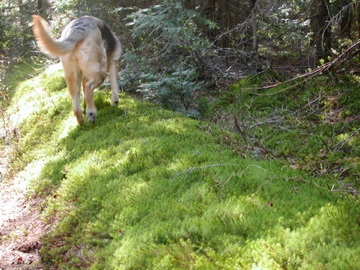
Turning the pages of the history book forward, the signs of recent history are easier to see and decipher. This land was settled as part of the Land Grants program in the 1880's. One of the conditions of the deal was that settlers had to clear 40 acres for farming (which would not have been an easy task). We can still see the furrows, now covered in moss, very clearly on our Mossy Trail.

You can still see the furrow (now covered in moss) from the farm days.
Throughout the property are piles of fieldstones. Every stone in every pile would have been lifted by hand and piled up out of the way of the field work. Very likely it was a job for the children to do.

One of many piles of fieldstone throughout the property.

Nicely intact section of fence, perhaps 100 years old.
In one spot just off the Mossy Trail, you can see the remains of a split rail fence covered in a lovely, vibrant moss. Was this to keep cows in? To mark a border? How long was it and who built it? We don't know and probably will never find out.

There are many narratives only hinted at throughout the forest--of current activity as well as the recent and distant past. Take a walk, keep your eyes open, and enjoy the mystery as much as the answers.


You can glimpse the split rail fence from the Mossy Trail.
: :   : :   : :

Discover the stories of the wildlife in our woods in Reading the Forest - Animal Tales.


Tuesday, April 10

Reading the Forest - Animal Tales

This is a work-in-progress for a busy beaver.
Just about anyone can enjoy a walk in the forest. You don't have to know your flora and fauna, your history or geology, in order to appreciate the fresh air, natural surroundings and gentle workout that comes with a hike through the woods. But if you're so inclined, you can get more out of the experience than a clear head and physical exercise. If you pay attention and read the signs, you'll see the forest tells a story.

Work of pileated woodpecker.
Actually, it tells many stories—of the creatures that call it home and the history that shaped the land in recent years and in the distant path. While we rarely get to see the actual animals in the woods (they're too shy and stealthy most of the time), we can see where they've been and what they've been up to.

A pair of pileated woodpeckers have been busy all around the property lately. We hear them rat-tat-tatting every day, but more than that, we see firsthand the results of their work. This is just one long-dead tree trunk that a woodpecker has "written" on. You don't even have to see the woodpecker to know it's been here, or to know it is one big bird.

We can also see that a cousin of the pileated has also been active. These neatly drilled holes are the work of a sapsucker. This smaller woodpecker makes the holes to get to the tree sap, eating both the sap and the insects that are drawn to it.
Neat holes drilled by a sapsucker.

Old scar on a tree, scratched open for sap.
Birds aren't the only forest inhabitants who like sap. This scar is a few years old, but you can clearly see the claw marks where a bear scratched through bark to get to the sap. 

Other animal stories are told by tracks and trails (pictured bottom), scat (not pictured!) and even hatched egg shells from a snapping turtle. The well-gnawed tree trunk (pictured top) is clear evidence of beaver activity.
Empty shells from hatched turtle eggs.

Snow is especially good at telling a story of what just happened. It's an excellent (though temperary) slate for recording tracks, trails, skirmishes and the food chain in action. I've seen a little track from some unfortunate little rodent end abruptly at a swish made from the wing feathers of some fortunate bird of prey. I didn't get a picture of that scene but this photo (taken after a wild turkey trotted through our yard) shows you what I mean about the wing swoosh.
A wing swoosh and footprints in the snow tell us a wild turkey was here.
Animals are just some of the character in the forest stories. Rocks, trees and even the earth have their own tales to tell. I'll have to save that for another post. This is one story that is, well, to be continued...

Moose track.

Moose trail.